

Maybe it’s one tooth you’ve never liked. Maybe it’s a small gap, an old bonding job that’s seen better days, or a smile you’re finally ready to change. Dental veneers are one of the most flexible ways to get there, and there are two real paths to choose from: composite and porcelain.
Both can get you a natural, brighter, more even smile. They just get you there differently, and they’re built for different situations, timelines, and budgets. Here’s how each one works, what it actually costs, and how to figure out which one fits you.
On this page
The Difference, At a Glance: Composite Veneers vs. Porcelain Veneers
| Composite Veneers | Porcelain Veneers | |
|---|---|---|
| Cost | $650 per tooth | $1,200 per tooth |
| Visits | Two: a consultation/digital scan, then a treatment appointment | Typically multiple visits: prep, temporary, fabrication, final placement |
| Tooth preparation | Minimal to none in most cases | Requires removing a thin layer of enamel |
| Best for | Staining whitening won’t fix, black triangles, chipped or aging bonding, minor reshaping, or trying the look before a bigger commitment | Deep or dark internal staining, heavy grinding, wanting the longest-lasting option regardless of cost |
| Longevity | Roughly 5–7 years | Roughly 10–15+ years |
| Repairability | Can typically be repaired or touched up directly | Damage usually means replacing the veneer |
| Insurance | Generally not covered (cosmetic); some teeth may qualify for partial coverage if there’s an underlying restorative need, reviewed at consultation | Same, generally not covered; same case-by-case exception may apply |
| Financing | 0% interest for 12+ months through Cherry | 0% interest for 12+ months through Cherry |
Composite Veneers
Composite veneers are a tooth-colored resin, the same material used in dental bonding, shaped and bonded directly onto your existing teeth to change their color, length, symmetry, or shape. We use a digitally planned, injectable mold technique: your new smile is designed digitally first, then a precise custom mold is used to inject and shape the composite in place. It’s a more predictable, symmetrical result than freehand bonding alone.
Composite veneers tend to be a good fit if:
- Your teeth are stained in a way whitening won’t fix, including white spots or uneven discoloration left behind by braces.
- You have “black triangles,” the small dark gaps that open up at the gumline between teeth.
- You have old bonding that’s chipped, yellowed, or just doesn’t look right anymore.
- You have a chip, a gap, or a tooth shape you’ve just never loved, no damage required.
- You want to see what a smile upgrade looks like before committing to porcelain. Composite costs meaningfully less per tooth and, in most cases, means little to no removal of your natural tooth structure.
The process: a cosmetic consultation and digital scan (this visit has a $250 records fee), then we design the exact shape, length, and symmetry digitally and fabricate a custom mold from that design. At your treatment appointment, we shape and bond the composite directly onto your teeth, using the exact custom mold, and finish with shaping and polishing. A single tooth is a much shorter visit than a full smile.
Composite veneers typically last 5 to 7 years. If a spot ever looks dull or picks up a stain, it can usually be polished or touched up chairside in minutes, no need to start over. For a closer look at the process and answers to common questions, see our full guide to composite veneers.


Porcelain Veneers
Porcelain veneers are thin, custom-made ceramic shells bonded to the front of your teeth. They’re the longer-lasting option, and they hold up especially well against the kind of deep, dark staining that composite and whitening can’t fully correct.
Porcelain veneers tend to be a good fit if:
- You have deep or dark internal staining that composite or whitening won’t resolve.
- You grind your teeth heavily and want a more durable material.
- You want the longest-lasting option and are comfortable with a higher upfront investment.
The process: porcelain typically involves a few more visits than composite. Your teeth are prepared and a mold is taken (this usually means removing a thin layer of enamel), temporary veneers are placed so you can preview your new smile, and a dental lab fabricates your final veneers. At your second visit, the temporaries come off and your custom porcelain veneers are permanently bonded and adjusted.
Porcelain veneers typically last 10 to 15 years or more with good care. Because the material is fabricated in a lab rather than shaped chairside, damage to a porcelain veneer usually means replacing it rather than a quick touch-up.
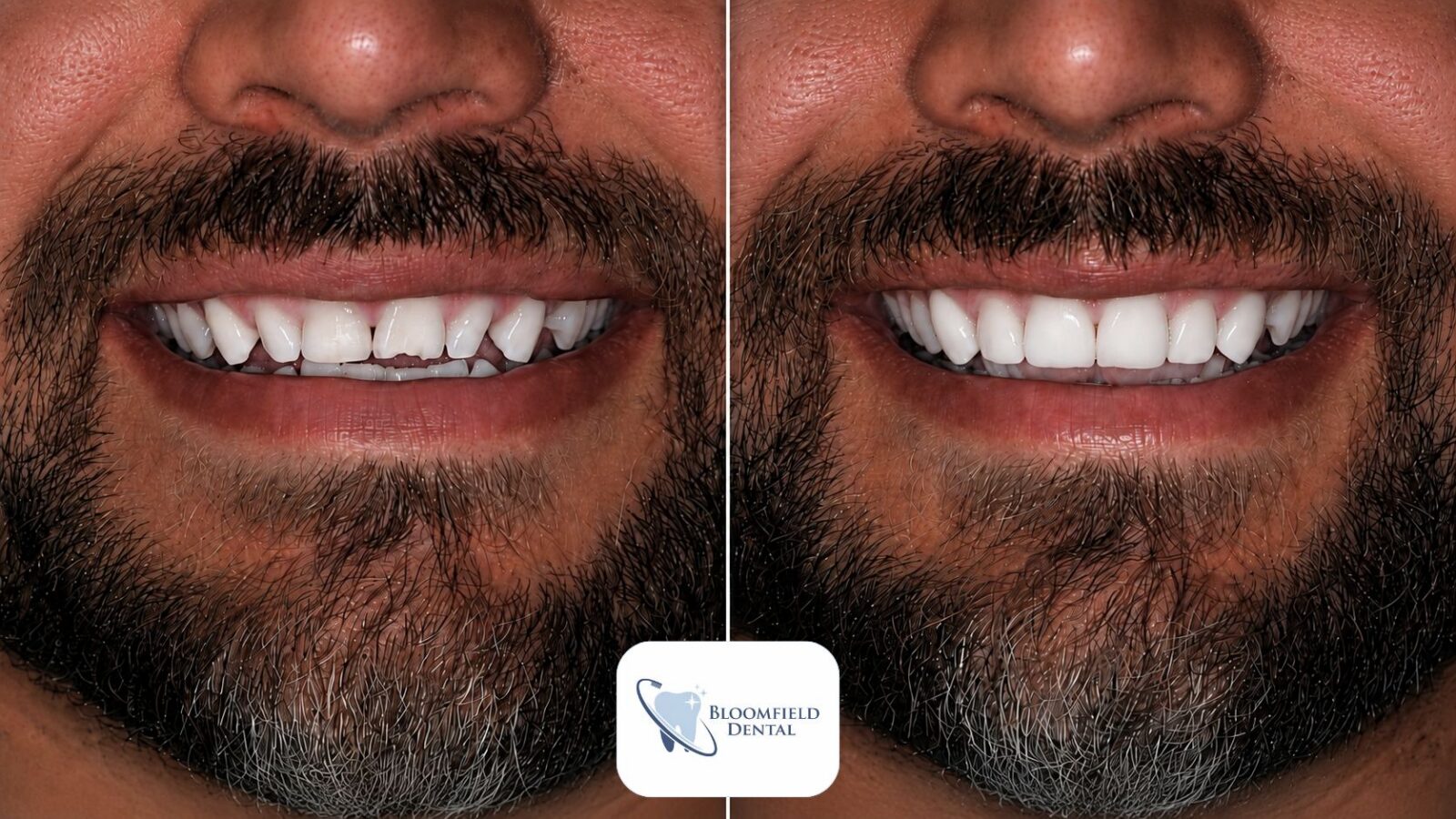
Neither option is objectively “better,” it depends on what you’re trying to fix, how long you want it to last, and what you’re comfortable spending right now. We’ll help you figure out which one actually fits your situation at your consultation.
Veneer Fees: Per Tooth or Full Smile
Veneers are priced per tooth, so your fee is based on exactly how many teeth we treat. A full smile makeover typically covers 8 teeth, the ones that show when you smile, though it commonly runs a couple teeth in either direction depending on your smile and your goals. Here’s what to expect for a single tooth and for a full smile, for composite and porcelain.
Composite Veneers
Sculpted chairside, in as few as two visits
Single Tooth
$650
Full Smile (8 teeth)
$5,200
(15% off all treatment with our Bloomfield Smile Membership: $553 per tooth, $4,420 for a full smile)
As low as $47/month per tooth or $369/month for a full smile, for 12 months with approved financing*
What’s included
✓ Free consultation and digital smile preview
✓ Digitally designed, injectable mold technique
✓ Shaping, polishing, and bite check at your visit
✓ A follow-up adjustment if you need one
Porcelain Veneers
Custom ceramic, built to last
Single Tooth
$1,200
Full Smile (8 teeth)
$9,600
(15% off all treatment with our Bloomfield Smile Membership: $1,020 per tooth, $8,160 for a full smile)
As low as $85/month per tooth or $680/month for a full smile, for 12 months with approved financing*
What’s included
✓ Free consultation and digital smile design
✓ Minimal enamel preparation
✓ Temporary veneers while yours are made
✓ Custom-fabricated porcelain, bonded at your final visit
*Monthly estimates reflect Bloomfield Smile Membership pricing ($350/year), 0% APR, 12 monthly payments, and no down payment, and are shown per tooth and for a full smile of 8 teeth. Your actual fee is based on the number of teeth we treat, commonly 6 to 10, and can run higher or lower than the full smile estimate above. Financing through Cherry is subject to credit approval, and approved terms may vary.
Dental Veneers FAQ
How many teeth can be treated with composite veneers?
As few as one tooth, or as many as your whole smile, it depends entirely on what you’re looking to change. A lot of patients assume “veneers” means a full smile makeover, but fixing a single chipped or discolored tooth is one of the most common reasons people come in for this.
Does it hurt?
Most patients don’t need anesthesia at all, since in many cases little to no natural tooth structure is removed. If your case calls for any adjustment to the tooth, we’ll numb the area first. Either way, it’s a much lower-discomfort process than most people expect.
How long do composite veneers last?
Typically 5 to 7 years, though it varies with how you care for them and habits like grinding or biting hard objects. When they do start to show wear, they can usually be touched up or repaired directly rather than replaced outright, one advantage composite has over porcelain.
Can composite veneers be whitened?
Not with teeth whitening, whitening works on natural enamel, not on composite resin, so the composite itself won’t lighten. If you’re planning to whiten your teeth, it’s best to do that first and match the composite to your new, brighter shade, rather than whitening afterward and ending up with a mismatch.
Will they stain?
They’re more prone to picking up stain over time than porcelain or natural enamel, especially with things like coffee, red wine, or tobacco. Good oral hygiene and routine cleanings help, and if staining does show up, it’s a straightforward polish or touch-up rather than a full redo.
Is this reversible?
In cases where we don’t need to adjust the natural tooth, yes, the composite can be removed with little to no lasting change to the tooth underneath. This is one of the reasons it’s a lower-stakes way to try a cosmetic change before committing to something permanent like porcelain.
Can I switch to porcelain veneers later if I want to?
Yes. Plenty of patients use composite veneers as a way to live with a new smile for a while before deciding whether to move to porcelain, there’s no penalty for changing your mind either direction.
What’s the difference between this and the bonding I’ve had done before?
Traditional bonding is sculpted freehand, one tooth at a time, which means results can vary depending on the day and the provider. Our process starts with a digital design and a custom mold built from that design, which gives more precise, symmetrical, and predictable results, especially when multiple teeth are being treated together.
Will insurance cover any of this?
Generally, no, cosmetic treatment like this isn’t something PPO plans cover. That said, if a specific tooth has a genuine underlying need (decay, a fracture, or failing old work), part of that tooth’s treatment may qualify for coverage. We’ll review your specific situation and benefits at your consultation rather than guess over the phone.
What if I can’t pay for this all at once?
We offer 0% interest financing for 12 months or more through our partnership with Cherry, so you can spread out the cost without paying interest.
How do I get started?
Book a cosmetic consultation with us. We’ll examine your teeth, talk through what you’d like to change, and take a digital scan to start planning your design (a $250 records fee applies to this visit). From there, we’ll walk you through your options and the cost before you decide anything.
Ready to Talk About Your Smile?
Whether it’s one tooth or your whole smile, we’ll walk you through composite and porcelain side by side and help you land on what actually fits your goals and your budget. We offer 0% interest financing for 12+ months through Cherry, so cost doesn’t have to be the thing that holds you back.
Call us at (610) 284-4770 or book online to schedule your cosmetic consultation. You can also see more real results on Instagram @bloomfield_dental or at bloomfieldavedental.com.