

Maybe it’s the back molar you lost years ago and never got around to replacing. Maybe it’s a front tooth that’s chipped, failing, or already gone, and you’ve been covering your smile with a hand instead of showing it. Whatever the reason a tooth is missing, and whatever has kept you from doing something about it, you’re not behind, and you’re not out of options.
A single missing tooth affects more than the gap itself. The neighboring teeth begin to drift, your bite changes, and the bone that once supported the root starts to change shape. The good news is that replacing one tooth is one of the most straightforward, well understood procedures in dentistry, and there are three real paths to get there: a partial denture, a ceramic bridge, and a dental implant. They differ in cost, timeline, and what happens to the teeth and bone around the space.
Here’s how each option works, what a single tooth dental implant costs here in Drexel Hill, and how to think about which one fits you. We place and restore implants for patients across Delaware County, and your consultation and insurance check are free.
On this page
Partial Denture vs. Ceramic Bridge vs. Dental Implant: The Difference at a Glance
| Partial Denture | Ceramic Bridge | Dental Implant | |
|---|---|---|---|
| How it stays in | Hooks onto surrounding teeth and gums | Cemented onto neighboring teeth | Anchored directly into the jaw like a tooth root |
| Surgery required | None | None | Implant placement |
| Look and feel | Natural-looking; may feel bulky at first | Natural-looking, fixed and stable | Closest to a natural tooth |
| Effect on nearby teeth | Supported by neighboring teeth | Requires reshaping adjacent teeth | Independent of neighboring teeth |
| Expected lifespan | Typically 5–10 years | Typically 15–20 years | Long-term solution |
| Relative investment | $$ | $$$ | $$$ |
| Best for | Patients seeking a removable, lower-cost option | Patients wanting a non-removable option without surgery | Patients seeking the most natural result |
Want a version you can print or share with family? Download our Single Tooth Replacement Options guide, or see more of our patient education guides.
Partial Denture: The Removable Option
A partial denture, sometimes called a removable partial, is a custom-made appliance that fills the gap left by a missing tooth. Thin clasps hook onto the teeth on either side to hold it in place, and it comes out for cleaning each night.
A partial denture tends to be a good fit if:
- You want the most affordable way to fill the space right away.
- You’re not ready for, or not a candidate for, a more permanent option yet.
- You’d like a straightforward, lower-maintenance solution while you decide on a longer-term plan.
- You have more than one tooth missing on the same side and want a single appliance to replace them together.
The process: most patients complete treatment in about 6 to 8 weeks, over four visits: a consultation and digital scan, impressions and records, a try-in so you can see and approve the fit before anything is finalized, and delivery. Future adjustments are simple if your bite or fit changes over time.
What to know: a partial denture rests partly on the neighboring teeth and gums, so it can feel a little bulky at first, most patients adjust within a couple of weeks. Because it doesn’t replace the tooth root, it doesn’t stop the bone underneath the gap from gradually changing shape over time.
Ceramic Bridge: A Fixed Option Without Surgery
A ceramic bridge replaces a missing tooth by anchoring a custom porcelain replacement to the healthy teeth on either side of the gap. Unlike a partial denture, it’s cemented in place, so it isn’t removed, it’s cared for exactly like your natural teeth.
A ceramic bridge tends to be a good fit if:
- You want a fixed, non-removable replacement without implant surgery.
- The teeth next to the gap already need crowns, or have large fillings or old dental work.
- You’d like a shorter overall timeline than an implant typically requires.
- You’re not a candidate for implant surgery, or would rather avoid one.
The process: most patients complete treatment in about 2 to 3 weeks, over three visits. At your consultation, we evaluate the teeth on either side of the space, then prepare them and take a digital impression, placing a temporary bridge while your permanent one is fabricated. At delivery, your custom ceramic bridge is cemented into place and adjusted for a comfortable bite.
What to know: to support the bridge, the teeth on either side need to be reshaped and covered with crowns, even if they were previously healthy. And because a bridge spans the gap rather than replacing the root, the bone underneath the missing tooth will still gradually change shape over time.
Dental Implant: The Closest Thing to a Natural Tooth
A dental implant replaces the entire tooth, root included. A small titanium post is placed directly into the jawbone where the root used to be, and once it has fused with the bone, a custom porcelain crown is attached on top. It’s the option that most closely recreates a natural tooth, in function and in how it feels day to day.
A dental implant tends to be a good fit if:
- You want a permanent, independent replacement that doesn’t rely on the teeth around it.
- The teeth next to the gap are healthy, and you’d rather not reshape them for a bridge.
- You want to protect the bone in that area for the long run.
- You’re ready to invest a bit more time and cost upfront for what’s typically the longest-lasting result.
The process: most patients complete treatment in about 4 to 6 months, over four visits. At your consultation, we take a digital scan and evaluate your bone to plan the implant’s exact position. At your surgical visit, the implant is placed, a minor procedure most patients tolerate very well. Over the next 3 to 4 months, the implant fuses with your jawbone, a process called osseointegration, and then we take a final scan and deliver your custom crown.
What to know: a dental implant is the only option of the three that replaces the tooth root, which is what keeps the surrounding bone stimulated and healthy over time. It requires a minor surgical step and the longest overall timeline of the three, but for most patients, it’s also the one they’re happiest with years later.
How Long Does Each Option Take? Timeline and Visits
Knowing what to expect makes the decision easier. Here is what each path typically looks like from start to finish.
Partial Denture
Approx. 6 to 8 weeks
Visit 1 Consultation and scan
Visit 2 Impressions and records
Visit 3 Try-in
Visit 4 Delivery
Future adjustments as needed
Ceramic Bridge
Approx. 2 to 3 weeks
Visit 1 Consultation
Visit 2 Tooth preparation and temporary
Visit 3 Delivery
Dental Implant
Approx. 4 to 6 months
Visit 1 Consultation and scan
Visit 2 Implant placement
3 to 4 months healing
Visit 3 Scan and impressions
Visit 4 Crown delivery
Why Timing Matters After Losing a Tooth
After a tooth is lost, the changes don’t stop at the gap. The bone that used to support the root can begin changing almost immediately, and the surrounding teeth can gradually tip and drift into the open space, sometimes within months. These are two photos of the same patient, six months apart.
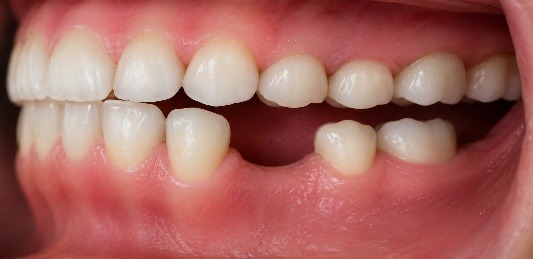
Shortly after extraction
Neighboring teeth still in position
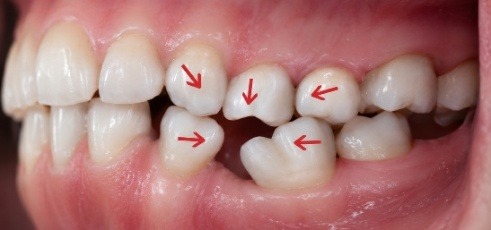
Six months later
Teeth begin to tip and drift into the space
When a space is left open, the neighboring teeth and the bone underneath gradually shift and reshape. Replacing a missing tooth sooner keeps your options simple, which usually means more straightforward treatment and a lower overall investment.
Did you know?
After a tooth is removed, the surrounding bone can begin changing almost immediately, and the greatest amount of bone loss tends to occur during the first year. In many cases, a bone graft can be performed to preserve the site and stimulate regrowth of your natural bone. The good news is that replacing the tooth, especially with an implant, helps protect and retain that bone.
This isn’t a reason to worry, and it isn’t too late if it’s already happened to you. It’s simply why we’d rather have this conversation now than after the space has had years to change your bite. Some patients choose to monitor the space for a while, and we’re glad to keep an eye on it at your routine visits. If and when you’re ready to move forward, we’ll walk you through exactly which of the three options fits your situation, your goals, and your budget.
Missing More Than One Tooth?
If you’re missing several teeth, facing multiple extractions, or already wearing a denture that doesn’t feel secure, replacing one tooth at a time may not be the most efficient path forward. Our full arch replacement options cover complete dentures, overdentures, and All-on-X, and may be a better fit for your specific case. Still weighing implants against dentures in general? Read our side-by-side comparison of dental implants and dentures, or see real results from our patients in the smile gallery.
How Much Does a Single Tooth Dental Implant Cost?
We quote single tooth implant treatment as one straightforward bundle fee, so you know your number before you begin. No separate bills for the implant, the abutment, and the crown along the way.
Single Tooth Dental Implant
Complete, from placement to final crown
$4,500
without insurance
As low as $450/month with approved financing*
What’s included
✓ Free consultation and complimentary insurance check
✓ Implant placement
✓ Custom-fabricated abutment and all-ceramic crown
✓ Every visit from placement to your final crown
*Financing through Cherry offers 0% interest for 12 or more months, subject to credit approval, and approved terms may vary. See all of our payment options. Bone grafting or an extraction, if your case needs one, is reviewed and quoted separately at your consultation. Partial denture and ceramic bridge fees vary by case and are quoted at your consultation as well.
We’ll Check Your Insurance for You, Free
Most PPO plans cover at least part of a single tooth replacement, and figuring out exactly what yours covers shouldn’t be a barrier to getting started. Bring us your insurance information and we’ll personally check your benefits and put together a clear estimate of your out-of-pocket cost, at no charge and with no obligation. It’s often the fastest way to find out this is more within reach than you assumed.
Does insurance cover dental implants?
We accept most PPO plans and will always put as much of your benefit toward your treatment as possible. Coverage for implants varies widely by plan, some cover a meaningful portion, others very little, which is exactly why we check it for you before you commit to anything.
Dental Implants FAQ
How much does a single tooth dental implant cost?
Our single tooth implant fee is $4,500 for patients without insurance, and that bundle covers everything from placement to your final crown. With approved financing through Cherry, that can be as low as $450 a month. If you do have insurance, we’ll check your benefits and give you an exact out-of-pocket estimate at no charge.
What’s included in the $4,500 fee?
Everything from your implant placement to your final custom crown: the implant itself, the abutment that connects it, your all-ceramic crown, and every visit in between. A free consultation and insurance check are included before you commit to anything. Bone grafting or an extraction, if your case needs one, is quoted separately and explained upfront.
How long does it take to get a single tooth implant?
Most patients go from consultation to final crown in about 4 to 6 months over four visits, and most of that time is simply healing while the implant fuses with your jawbone. A partial denture can be finished in about 6 to 8 weeks, and a ceramic bridge in about 2 to 3 weeks, if you’d rather move faster.
How long do dental implants last?
The implant itself is designed to be a long-term solution and, with good hygiene and regular checkups, often lasts for decades. The crown on top is the part that sees daily wear and may eventually need replacement, similar to any other crown. For comparison, a ceramic bridge typically lasts 15 to 20 years and a partial denture about 5 to 10.
Is a dental implant better than a bridge?
It depends on the teeth around the space. An implant stands on its own, replaces the root, and helps preserve the bone, which is why we often recommend it when the neighboring teeth are healthy. A bridge can be the better choice when those neighboring teeth already need crowns, when you’d rather avoid surgery, or when you want a shorter timeline.
Is bone grafting always necessary with an implant?
No. Many patients have plenty of healthy bone and don’t need it. If your consultation shows the area needs extra support, we’ll explain why and provide a clear cost before moving forward, it isn’t automatically part of every case.
Does it hurt?
Most patients describe implant placement as easier than they expected, similar to having a tooth removed. Discomfort afterward is typically mild and managed with over-the-counter medication and ice for a few days.
Will my insurance cover any of this?
It depends on your specific plan, many PPO plans cover at least part of a single tooth replacement. Rather than guess, we’ll personally check your benefits and give you a clear, free estimate before you decide on anything.
What if I can’t pay for this all at once?
We offer 0% interest financing for 12 months or more through our partnership with Cherry, so the $4,500 bundle fee can be spread out to as low as $450 a month with approved financing.
I’ve been avoiding this for years, is it too late?
It’s rarely too late. Bone and the surrounding teeth do change over time when a space is left open, but we regularly help patients who’ve waited years get back on track, sometimes with a small adjustment to the plan, not a bigger problem than they expected.
Can I start with a partial denture or bridge and switch to an implant later?
In many cases, yes, though earlier is generally easier on the surrounding bone and teeth. We’ll give you a clear picture of what changing paths later would involve, so you can decide with your specific timeline and budget in mind.
Who places the implants?
Both Dr. William Kessler and Dr. David Yarmark place and restore implants here at Bloomfield Dental. Both are Fellows of the Resnik Implant Institute, with advanced training specifically in implant dentistry, and both completed a hospital-based residency at Albert Einstein Medical Center after dental school at the University of Pennsylvania. You’re treated by the same two doctors from your first consultation through your final crown.
How do I get started?
Call us at (610) 284-4770 or book online for a consultation at our Drexel Hill office. We’ll evaluate your specific situation, walk you through partial denture, ceramic bridge, and implant options side by side, and check your insurance benefits at no cost, so you can decide with a clear, complete picture in front of you.
Ready to Talk About Your Options?
Whether you’ve been missing a tooth for a few weeks or a few years, there’s a straightforward path forward from wherever you’re starting. We’ll walk you through partial dentures, ceramic bridges, and dental implants side by side, check your insurance at no cost, and give you a clear number before you decide on anything. We accept most PPO plans and offer 0% interest financing for 12+ months through Cherry, so cost doesn’t have to be what holds you back.
Bloomfield Dental is an independent, locally owned practice at 4130 Bloomfield Ave in Drexel Hill, PA, caring for patients from Drexel Hill, Havertown, Springfield, Upper Darby, and across Delaware County. Call us at (610) 284-4770 or book online to schedule your consultation. You can also see more real results on Instagram @bloomfield_dental or at bloomfieldavedental.com.