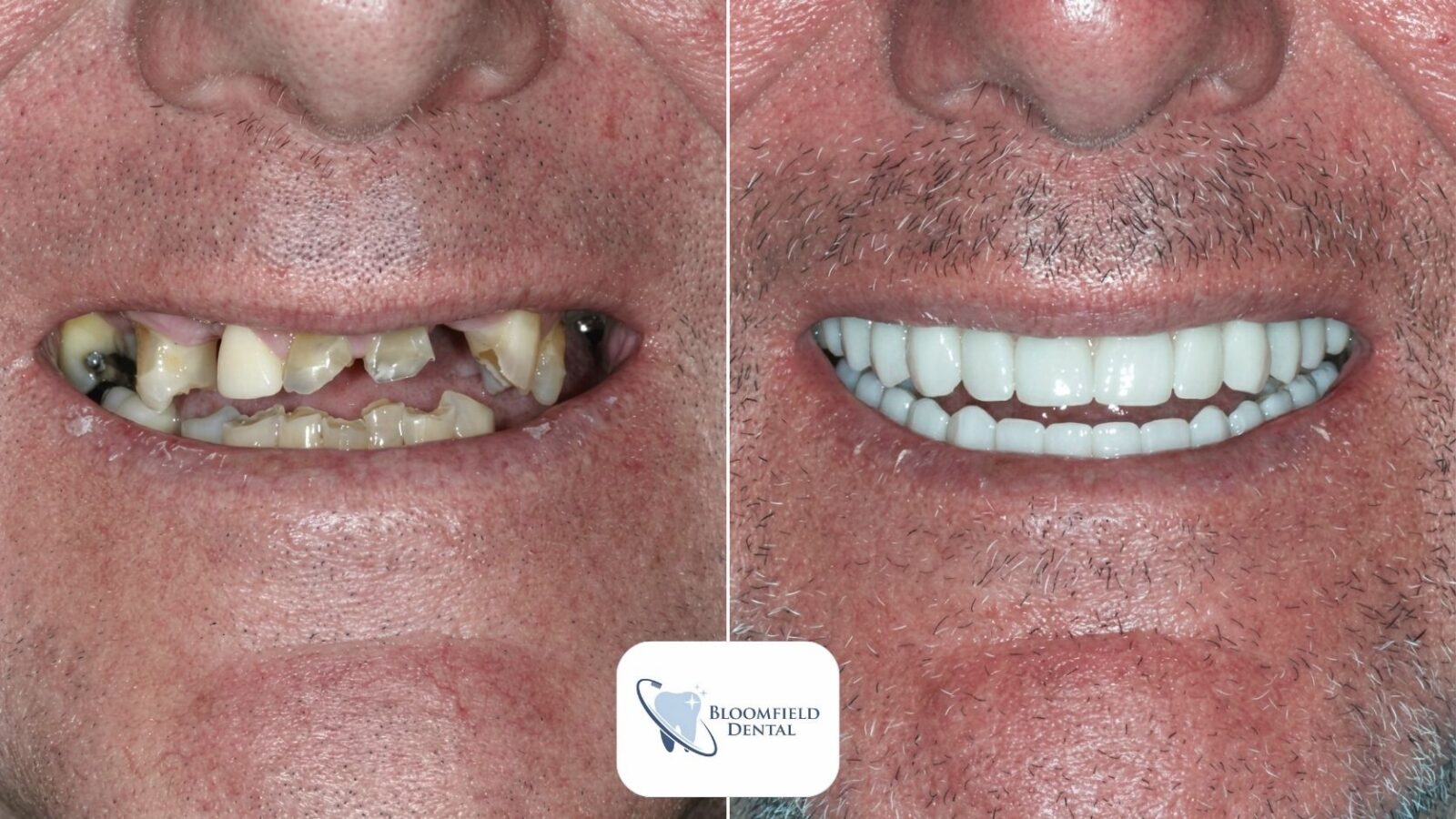
Maybe it’s a denture that’s never fit right. Maybe it’s years of losing teeth one at a time until there’s almost nothing left to work with. Maybe you’ve been told there isn’t much left to save. If you’ve been living with failing teeth, missing teeth, or a denture that never quite feels like yours, it’s easy to assume you’re past the point where anything permanent is possible.
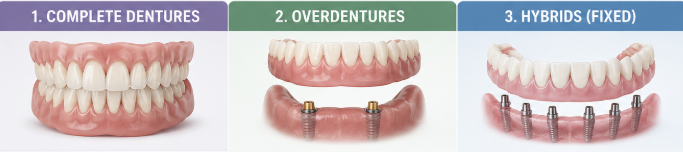
You’re not. Losing most or all of the teeth in an arch is more common than people think, and full arch rehabilitation rebuilds an entire upper or lower set of teeth. For most people who believe their situation is “too far gone,” this is exactly the kind of case it was designed for. There are three real paths to get there: a complete denture, an overdenture that snaps onto implants, and an All-on-X hybrid, a fixed set of teeth permanently anchored to implants. They differ in cost, stability, timeline, and what your day-to-day life looks like afterward.
Here’s how each option works, what you can eat and when, how long it takes, and how to think about which one fits you.
On this page
The Difference, At a Glance: Complete Dentures vs. Overdentures vs. All-on-X
| Complete Denture | Overdenture | All-on-X (Hybrid) | |
|---|---|---|---|
| How it stays in | Rests on the gums | Snaps onto implants | Permanently fixed to implants |
| Implants needed | None | 4 to 6 | 4 to 6 |
| Surgery | Extractions, if any teeth remain | Implant placement | Implant placement |
| Teeth on surgery day | A removable denture | A removable interim denture | A fixed interim set of teeth |
| Daily care | Remove and clean nightly | Remove and clean nightly | Brush like natural teeth |
| Chewing strength | Least stable, best for softer foods | More stable, handles more variety | Most stable, no restrictions once final teeth are placed |
| Roof of mouth | Usually covers the palate (upper) | Often covers the palate | No palate coverage |
| Speech and confidence | May move or slip | More secure | Feels most like natural teeth |
| Relative investment | $ | $$ | $$$ |
| Timeline | 6 to 8 weeks (about 16 weeks if teeth are removed) | About 6 months | About 5 to 6 months |
| Expected lifespan | 5 to 10 years before replacement or a major reline | Denture and attachments need periodic replacement | Long-term solution with proper care |
| Helps preserve the jawbone | No | Yes | Yes |
| Financing | 0% interest for 12+ months through Cherry | 0% interest for 12+ months through Cherry | 0% interest for 12+ months through Cherry |
Want a version you can print or share with family? Download our Full Arch Replacement Options guide.
Replacing just one tooth, or a couple? Our single tooth replacement options page compares partial dentures, ceramic bridges, and single tooth dental implants, with fees and timelines for each.
Complete Dentures
A complete denture is a full set of removable teeth that rests directly on your gums. It’s the option most people picture when they hear the word “denture,” and it’s still a sensible choice for the right person.
A complete denture tends to be a good fit if:
- You want the most affordable full arch option.
- You’re not able to, or not interested in, having implant surgery.
- You’re comfortable with a removable appliance and a nightly cleaning routine.
- You’d like to start with a denture now and keep the door open to adding implant support later.
The process: most patients complete treatment in 6 to 8 weeks, over about five visits: a consultation, impressions, a try-in so you can see and approve the look and fit, and delivery. If you still have teeth that need to be removed, they’re taken out at the delivery visit and your new denture goes in the same day. Your gums then heal and reshape for about two months, and we reline the denture so it fits snugly against the healed tissue. With extractions, plan on roughly 16 weeks start to finish.
What you can eat: this is the most limited of the three options. Complete dentures work best with softer foods, such as pasta, cooked vegetables, fish, eggs, ground meats, and soft fruit. Very hard, sticky, or chewy foods (whole nuts, caramel, crusty bread, corn on the cob, tough steak) can dislodge the denture or create sore spots, and most patients adjust their diet around this long term.
The tradeoffs to understand: an upper denture usually covers the roof of your mouth, which some patients find changes how food tastes and feels. Because a denture doesn’t stimulate the jawbone the way a tooth root does, the bone underneath gradually shrinks over time, so fit loosens and a denture typically needs replacement or a major reline every 5 to 10 years.
Overdentures
An overdenture is still removable, but instead of resting on your gums alone, it snaps securely onto four to six implants. It’s a real middle ground between a complete denture and a fixed solution, and for many patients it strikes the best balance of cost, stability, and ease of care.
An overdenture tends to be a good fit if:
- You want far more stability and confidence than a traditional denture, without the investment of a fixed arch.
- You like the idea of taking your teeth out to clean them each night.
- Your current denture slips, clicks, or needs adhesive to get through the day.
- You want a solution that helps preserve your jawbone.
The process: plan on about 6 months and six visits. We start with a consultation and records, then impressions and a try-in. At your surgery visit, your implants are placed and you go home with a removable interim denture. After about three months of healing, while the implants fuse with your jawbone, we connect the attachments (abutments) and take final impressions, then deliver your finished overdenture.
What you can eat: a clear step up from a complete denture. Because the implants anchor it in place, you get more bite strength and can handle more variety, including most meats, raw fruits and vegetables, and everyday foods. Very hard or sticky foods are still worth approaching with some care, since you’re biting on a removable appliance rather than a fixed one.
The tradeoffs to understand: it’s much more secure than a complete denture, but it’s still removable, it often still covers the palate, and the small attachments that let it snap in and out wear over time and need periodic replacement, as does the denture itself. If what you want is teeth that never come out, the next option is the one to look at.
All-on-X Hybrid (Fixed Teeth)
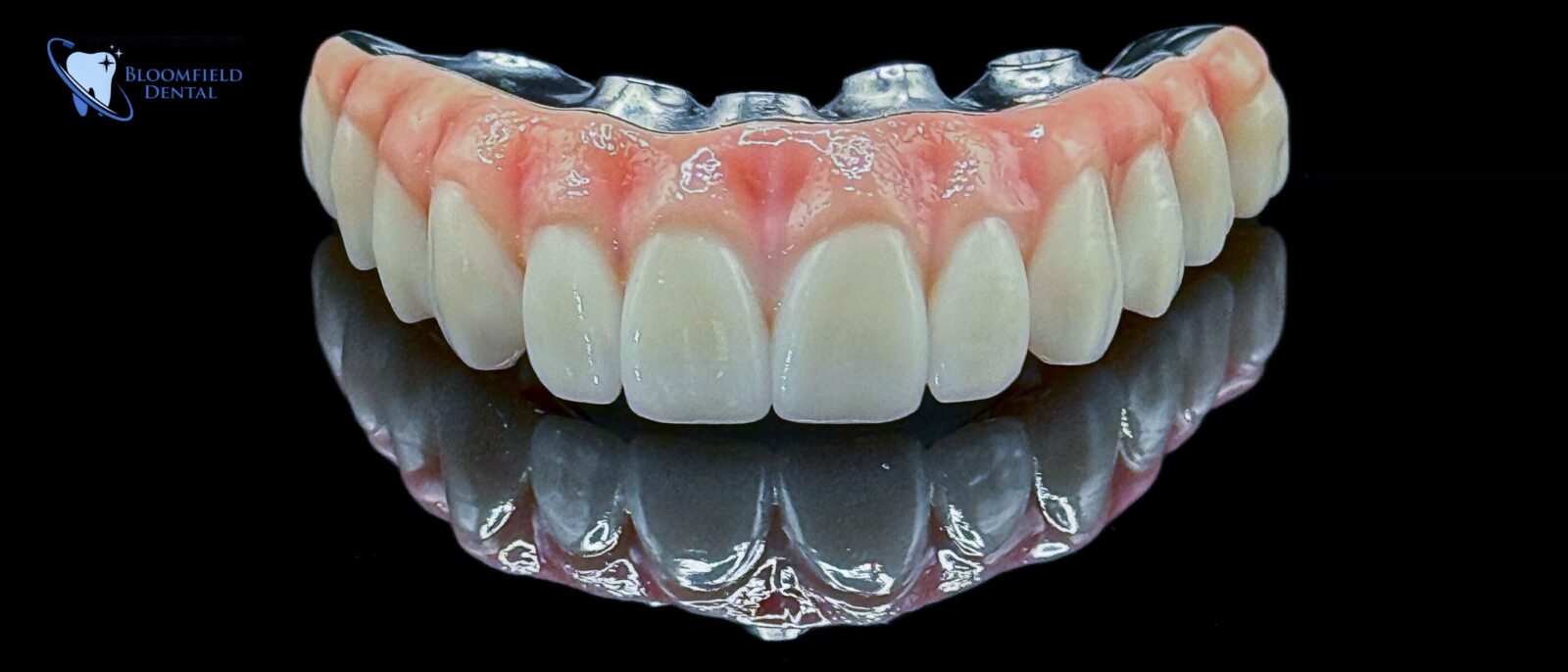
This is the option for patients who don’t have enough healthy, stable teeth left to support a fixed bridge off their natural teeth alone, whether from gum disease, years of failing dental work, or a denture that was never going to be a permanent answer. Instead of relying on your remaining teeth, a full arch of fixed teeth is anchored entirely to four to six implants, placed in the strongest, most strategic positions in your jaw. The exact number depends on your bone and your case, which is where the “X” comes in.
Unlike an overdenture, this arch does not come out at home. It’s permanently attached, you brush it like natural teeth, and it has no plate covering the roof of your mouth. Only we remove it, during periodic maintenance visits.
What “same-day teeth” actually means
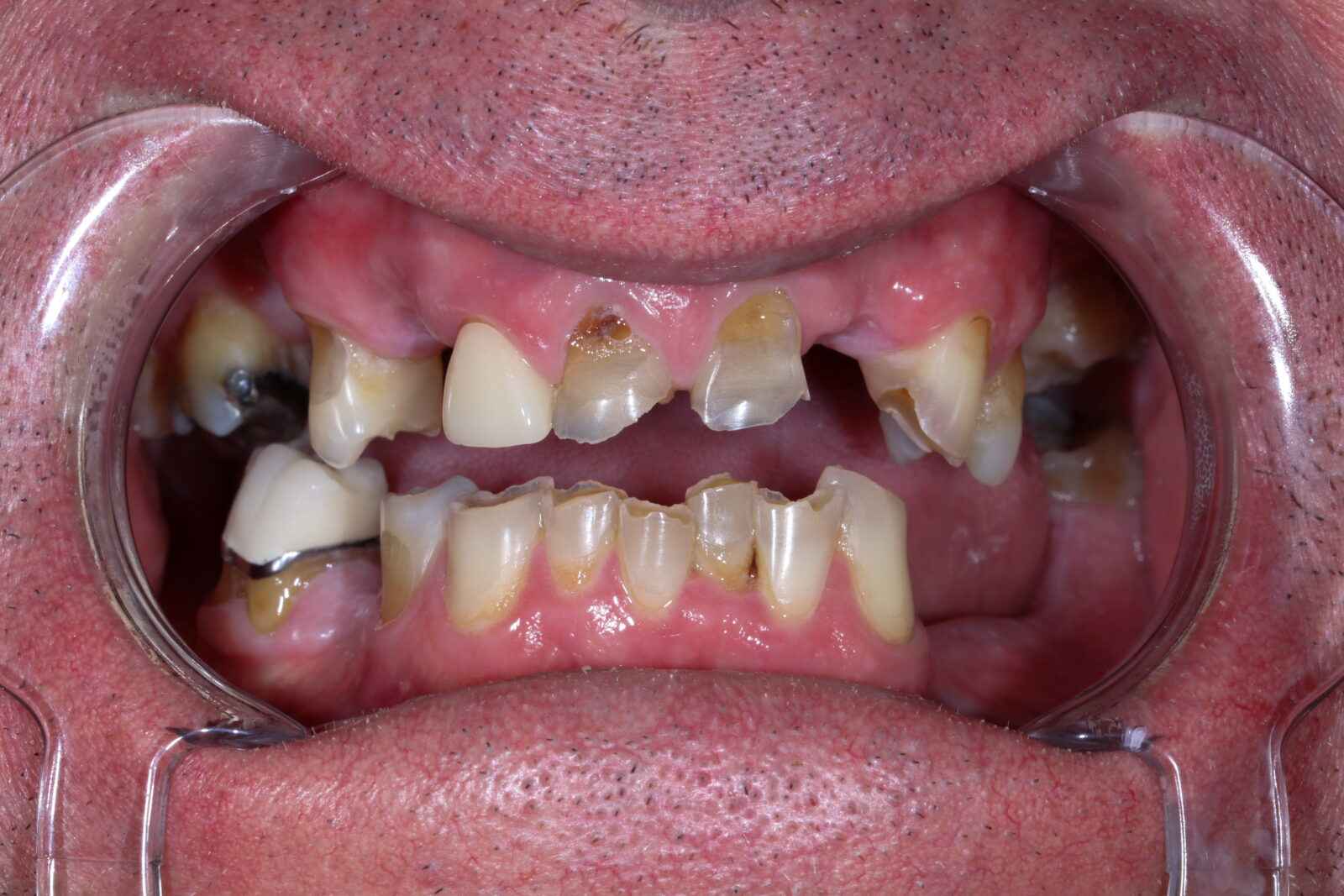
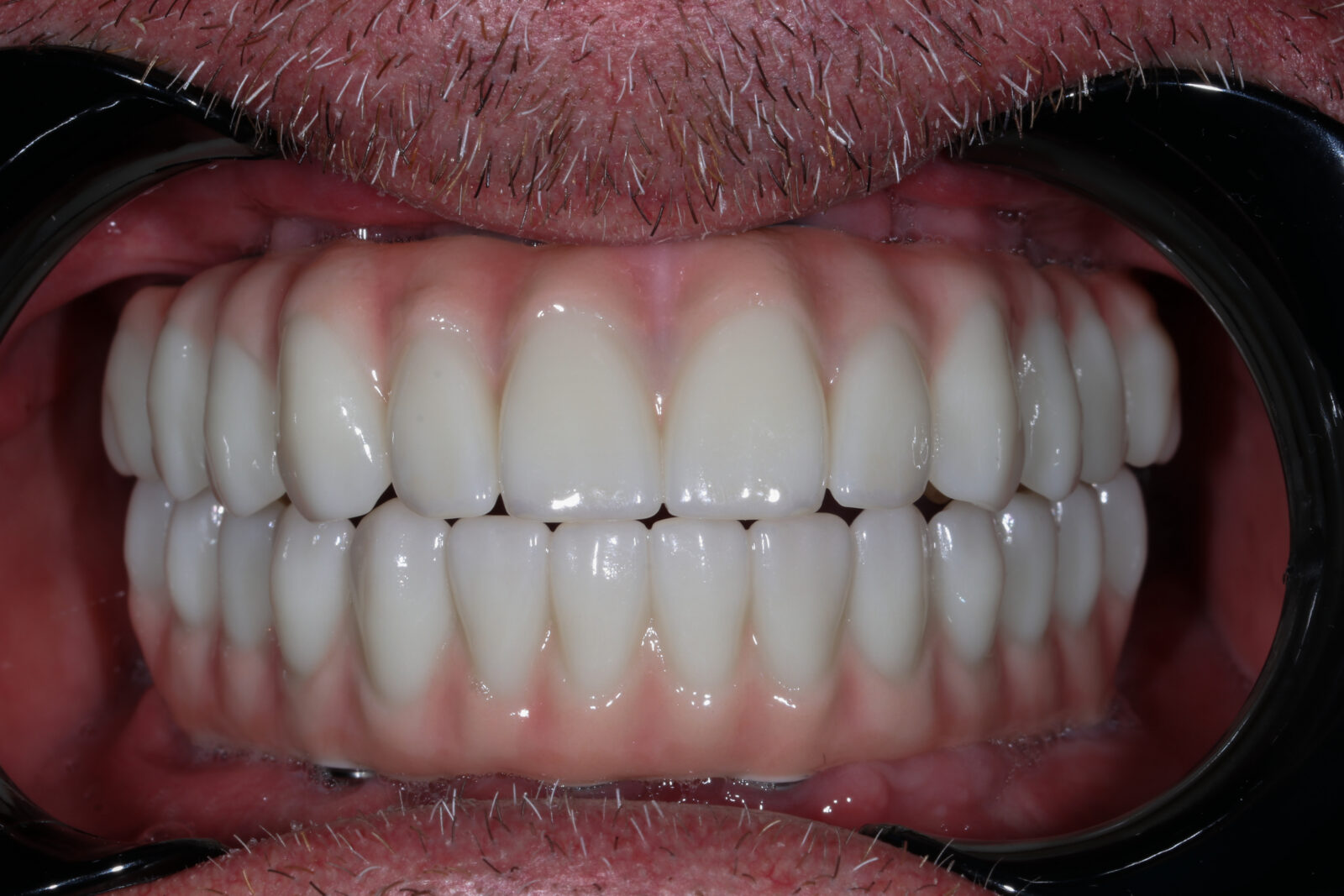
This is one of the most misunderstood parts of the process, so let’s be clear. On the day of your surgery, once any remaining teeth that can’t be saved are removed and your implants are placed, you leave that same day with a full, fixed set of teeth attached to your implants. You don’t go home with a gap, and you don’t go home with a removable denture. From day one, you can speak, smile, and eat (soft foods, at first) with fixed teeth.
That first set is an interim prosthesis made from PMMA, a strong, high-quality dental acrylic. It’s designed to closely match the shape, shade, and bite planned for your final teeth, and you wear it while your implants fuse with your jawbone over the following months, a process called osseointegration. It is fixed and functional, but it isn’t your final set. Once healing is complete, we take new digital impressions of your healed mouth, you try in your final design, and your interim teeth are replaced with your final restoration, most often milled zirconia. Your final teeth build on everything your interim set taught us about your bite, your smile, and your speech, in a material that’s stronger and more stain-resistant for the long run.
The full timeline
Most patients go from first visit to final teeth in about 5 to 6 months, over five visits.
Visit 1, consultation and records. We evaluate your bone, your remaining teeth, and your overall health, including 3D imaging, and build a digital plan for exactly where your implants will go.
Visit 2, surgery day. Any teeth that can’t be saved are removed, your implants are placed, and your fixed interim teeth are attached before you leave. Recovery over the next several days is similar to having teeth removed, with some swelling and tenderness managed with medication and ice.
About 3 months of healing. Your implants integrate with your jawbone while you live in your fixed interim teeth.
Visit 3, impressions. Once healing is confirmed, we take precise digital impressions of your implants and gums.
Visit 4, try-in. You see and approve the look and bite of your final teeth before anything is finalized.
Visit 5, delivery. Your final zirconia arch is placed and adjusted. From here, it’s simply your teeth.
What you can eat, and when
The first few days after surgery: liquids and very soft foods, such as smoothies, protein shakes, soups, mashed potatoes, yogurt, and applesauce. No biting or chewing yet.
Weeks two through six: soft, easy-to-chew foods as swelling settles, such as scrambled eggs, pasta, fish, ground meats, and well-cooked vegetables.
The rest of the time you’re in your interim teeth: you can gradually widen what you eat, but we’ll ask you to avoid very hard, crunchy, or sticky foods (ice, hard candy, whole nuts, raw carrots, tough steak). Your PMMA interim teeth are fully fixed, but they aren’t as strong as your final zirconia arch and can chip under heavy force, and your implants are still settling in.
Once your final zirconia teeth are placed: no dietary restrictions. Zirconia is extremely strong and made to handle the foods you may have been avoiding for years. The only habits worth keeping are the ones we’d recommend to anyone: don’t open packages with your teeth, and go easy on chewing ice.
The real pros and cons
What patients gain: fixed teeth that never come out, no adhesive, no plate covering the roof of your mouth, the strongest and most natural-feeling bite of the three options, and implants that help preserve your jawbone and the support of your face. For many patients, it’s also the biggest same-day confidence change we offer.
What it requires: it’s the largest investment of the three options, it involves surgery and a healing period, and while the final arch is only removed by us, it still needs regular cleanings and checkups, plus occasional maintenance of its components over the years, the same way natural teeth need ongoing care.
Why Replacing a Full Arch Matters
Tooth roots keep your jawbone stimulated and strong. Once teeth are gone, that bone gradually shrinks, and implant-based options act like natural roots to help preserve it. Your teeth and jawbone also support your lips and cheeks, so replacing a full arch helps maintain a natural, full profile. And a stable, complete bite lets you eat a varied diet comfortably, speak clearly, and smile, laugh, and be in photos without a second thought.
State-of-the-Art Materials, Built for the Long Run
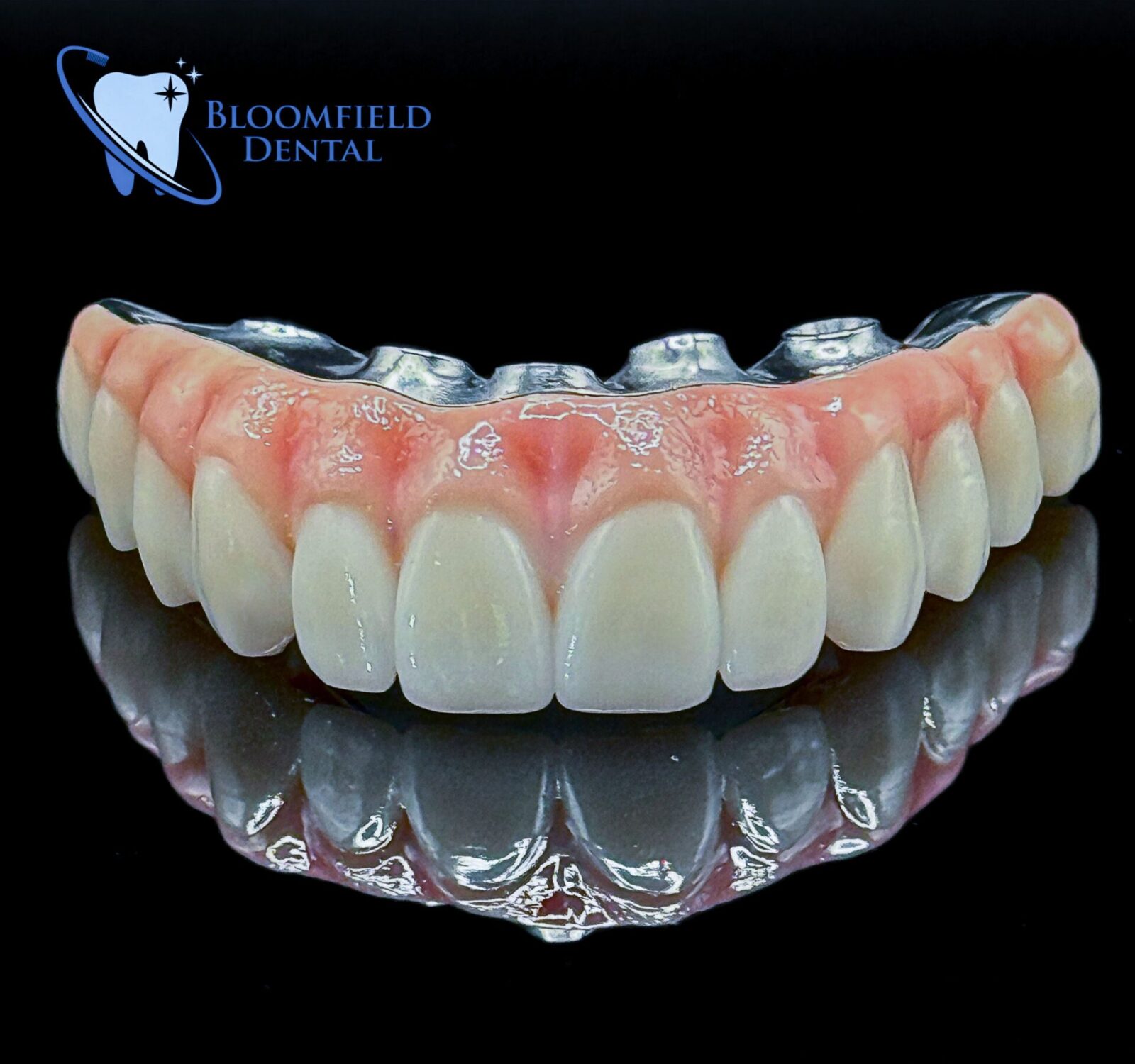
Every full arch case starts with a digital plan, not a guess. We use 3D imaging and digital scans to map your bone and design your new arch before treatment begins, which is what allows us to place implants precisely and build teeth that fit well from the start. Titanium implants bond directly with your jawbone, the same biocompatible material used in implant dentistry for decades. Your interim teeth are milled from PMMA, and your final teeth, in most cases, are milled from zirconia, chosen for its strength, its resistance to staining, and how closely it can be shaped and shade-matched to look like natural teeth. Every step, from your first scan to your final arch, is planned around one outcome: you leaving with teeth that fit, function, and look right.
Still weighing implants against dentures in general? Read our side-by-side comparison of dental implants and dentures.
Full Arch Fees: One Price, Everything Included
We quote full arch treatment as one all-inclusive fee per arch, so you know your number before you begin. Your fee covers your implants, any extractions, bone preservation grafting, your temporary teeth, your final teeth, and every visit in between. Your consultation is free.
Overdenture
Removable teeth that snap onto implants
Single Arch
$16,000
Both Arches
$32,000
(15% off all treatment with our Bloomfield Smile Membership: $13,600 per arch)
As low as $1,134/month for 12 months with approved financing*
What’s included
✓ Free consultation
✓ 4 to 6 implants per arch
✓ All extractions
✓ Bone preservation grafting
✓ Removable interim denture
✓ Final implant-retained overdenture
✓ Every visit in between
All-on-X Fixed Teeth
Permanent teeth, fixed the day of surgery
Single Arch
$24,000
Both Arches
$48,000
(15% off all treatment with our Bloomfield Smile Membership: $20,400 per arch)
As low as $1,700/month for 12 months with approved financing*
What’s included
✓ Free consultation
✓ 4 to 6 implants per arch
✓ All extractions
✓ Bone preservation grafting
✓ Fixed PMMA interim teeth, same day
✓ Final milled zirconia teeth
✓ Every visit in between
*Monthly estimates are per arch and reflect Bloomfield Smile Membership pricing ($350/year), 0% APR, 12 monthly payments, and no down payment. Financing through Cherry is subject to credit approval, and approved terms may vary.
What about insurance?
We’ll always work to put as much of your insurance benefit toward your treatment as possible, and we’ll review your coverage with you before anything begins. That said, full arch cases are generally an out-of-pocket investment. Most dental plans cap yearly benefits far below the cost of this kind of treatment, and many limit or exclude implants. That’s exactly why we keep our fees all-inclusive and offer membership savings and 0% financing, so you can plan around a clear number from day one.
Full Arch Rehabilitation FAQ
Do I have to be missing all my teeth to be a candidate?
No. Many patients we treat still have some natural teeth left, they just aren’t healthy or stable enough to build a long-term solution around. If your remaining teeth are failing from gum disease, old dental work, or repeated breakdown, full arch treatment replaces the whole arch at once rather than repairing it one tooth at a time.
What does “teeth in a day” actually mean? Are they permanent that day?
With an All-on-X hybrid, you leave surgery with fixed teeth attached to your implants, not a removable denture and not a gap. That first set is a PMMA interim prosthesis, built to look and function like real teeth right away. Your final zirconia teeth are placed after healing, typically 5 to 6 months from your first visit. Both are fixed teeth; they’re just different materials for different stages of healing.
Is the surgery painful?
Most patients describe recovery as similar to having teeth removed, just more of it in one visit. We’ll go over anesthesia and sedation options at your consultation so you’re comfortable with the plan well before surgery day, and most discomfort afterward is handled with medication and ice over the first few days.
How many implants will I need?
For both overdentures and All-on-X, most cases use four to six implants. The right number for you depends on your bone and the design of your new teeth, and we’ll determine it from your 3D imaging during planning.
What’s the difference between All-on-4 and All-on-X?
All-on-4 refers to a four-implant approach. All-on-X is the broader term for fixed full arch teeth on implants, since the right number, four, five, or six, depends on your case.
How long until I have my final teeth?
For All-on-X, about 5 to 6 months from your first visit, including about three months of healing. For overdentures, about 6 months. For complete dentures, 6 to 8 weeks, or about 16 weeks if teeth need to be removed first. With every option, you’re not without teeth while you heal.
Can I start with a denture and add implants later?
Yes. Many patients begin with a denture and add implant support later, while others go straight to a fixed solution. If budget or timing is a factor right now, we can plan a path that starts where you’re comfortable and leaves room to upgrade.
What does the fee include?
Everything from your first treatment visit to your final teeth: your implants, any extractions, bone preservation grafting, your temporary teeth, your final teeth, and every visit in between. Your consultation is free, and there are no separate bills along the way.
Will insurance cover any of this?
We accept most PPO plans, and we’ll put as much of your insurance benefit toward your treatment as we can. Full arch cases are generally out of pocket, though, since most plans’ yearly maximums are far below the cost of treatment and many limit implant coverage. We’ll review your specific benefits with you before treatment begins.
What if I can’t pay for this all at once?
Two things help. Our Bloomfield Smile Membership takes 15% off all treatment, and financing through Cherry offers 0% interest options for 12 months or more. Together, All-on-X fixed teeth can be as low as $1,700/month and an overdenture as low as $1,134/month per arch for 12 months with approved financing.
How do I care for a fixed full arch?
Brush it like natural teeth, and use a water flosser to clean around and underneath the arch where it meets your gums. Beyond that, regular cleanings and checkups with us let us monitor your implants and the fit of your teeth over time.
My current denture never fit right. Can this fix that?
Often, yes. Many patients who choose an overdenture or All-on-X have been living with a denture that slips, clicks, or needs adhesive to stay put. If that sounds familiar, it’s worth a conversation about what a more secure option would look like for you.
How do I know which option is right for me?
It comes down to your implant candidacy, your goals for how your teeth look and function, how you want to care for them, and your budget. At your consultation, we’ll lay out which options are realistic for your case, with clear tradeoffs for each, so you can make the decision that fits you.
Ready to Talk About Your Options?
Whether you’re missing a few teeth, most of them, or you’re living with a denture that’s never worked the way it should, there’s a comfortable path forward from wherever you’re starting. We’ll walk you through complete dentures, overdentures, and All-on-X side by side, with a clear timeline and cost for each, so you can choose with confidence. We accept most PPO plans and offer 0% interest financing for 12+ months through Cherry, so cost doesn’t have to be what holds you back.
Call us at (610) 284-4770 or book online to schedule your free full arch consultation. You can also see more real results on Instagram @bloomfield_dental or at bloomfieldavedental.com.