
Every June, the dental world celebrates Oral Health Month and while that might sound like a holiday only a dentist could love, it’s a good reason for the rest of us to pause and ask a simple question: when was the last time I really thought about my mouth?
For most people, the honest answer is “only when something hurts.” That’s understandable. Life is busy, and teeth tend to fly under the radar until they don’t. But here at Bloomfield Dental in Drexel Hill, we like to think of your mouth as less of a standalone body part and more of a window one that often shows us what’s happening with the rest of your health long before other signs appear.
So this month, we want to walk you through a few things that happen at a routine dental visit, why they matter beyond your smile, and a couple of everyday habits that protect both your teeth and the rest of you. No scare tactics. Just the stuff worth knowing.
The screening you didn’t know you were getting
Here’s something many patients are surprised to learn: every time you come in for a checkup with us, you’re getting an oral cancer screening whether you asked for one or not.
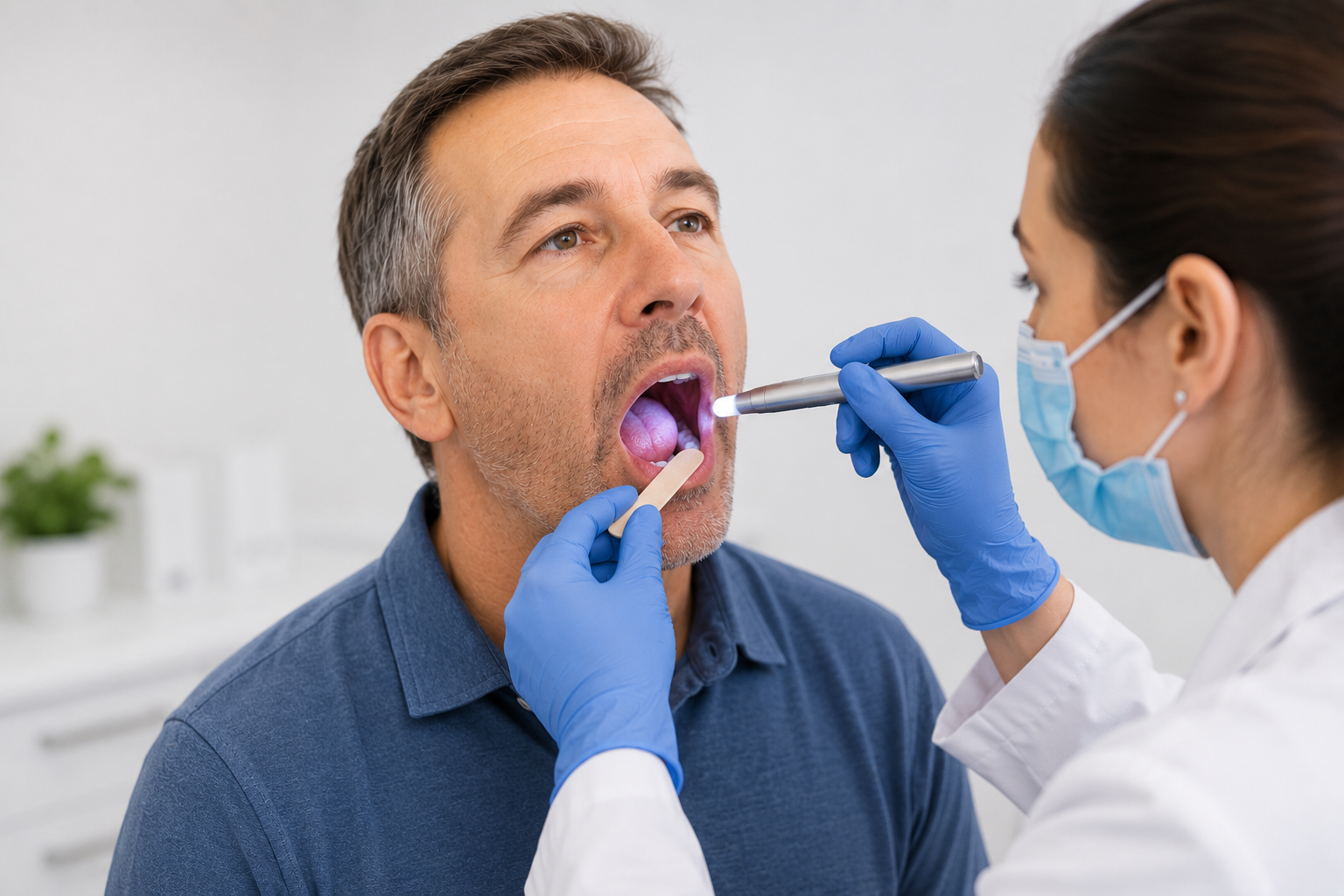
It takes only a couple of minutes, and it’s completely painless. We gently check the soft tissues of your mouth, your tongue, the floor and roof of your mouth, your throat, and the lymph nodes around your jaw and neck, looking for anything unusual a sore that hasn’t healed, a patch of color that shouldn’t be there, a lump you might not feel on your own.
Why does this matter so much? Because oral cancer is highly treatable when it’s caught early and far less so when it isn’t. The challenge is that early oral cancer often doesn’t hurt, which means people frequently don’t notice it themselves. That’s exactly why having a trained set of eyes look every six months makes such a difference. It’s one of the quietest, most valuable things that happens during a visit, and it’s a big part of why regular checkups are about more than just cleaning teeth.
If it’s been a while since your last exam, this is a gentle nudge not a guilt trip. Coming back in is easier than you’d expect, and that screening alone is worth the trip.
Good hygiene, done simply
We promise not to lecture you about flossing. (Well, mostly.) But Oral Health Month is a fitting time for a quick, no-nonsense refresher, because the basics done consistently really do most of the heavy lifting.
A solid daily routine looks like this:
- Brush twice a day, for two full minutes, with a soft-bristled brush and fluoride toothpaste. Most of us short-change ourselves on time, so a phone timer or an electric brush with a built-in timer can genuinely help.
- Clean between your teeth once a day. Floss is the classic tool, but if you find it awkward, floss picks, water flossers, and interdental brushes all work. The best tool is the one you’ll actually use.
- Go easy on the pressure. Brushing harder doesn’t get teeth cleaner it just wears down enamel and irritates your gums. Think “gentle and thorough,” not “scrub.”
- Don’t skip the tongue. A quick pass with your brush helps with freshness and reduces bacteria.
And then there’s the part no toothbrush can replace: a professional cleaning. The hardened buildup (tartar) that forms below the gumline can’t be removed at home, no matter how diligent you are. That’s where we come in and where catching small problems early saves you from bigger, costlier ones down the road.
The surprising link between your gums and your heart
This is the part of Oral Health Month that tends to make people sit up a little straighter. Your oral health and your overall health aren’t separate stories they’re chapters of the same book.
Researchers have noticed for years that people with gum disease (periodontitis) are more likely to also have cardiovascular problems, like heart disease. The leading explanation is inflammation: gum disease is a chronic, low-grade infection, and the same inflammation that damages the tissue and bone around your teeth appears to be connected to inflammation elsewhere in the body, including the blood vessels.
A fair, honest note here: scientists describe this as a strong association rather than a proven cause-and-effect relationship. Healthy gums won’t single-handedly protect your heart, and brushing isn’t a substitute for cardiac care. But the connection is real enough that taking care of your mouth is now widely understood as one meaningful piece of taking care of your whole body. The mouth-body link doesn’t stop at the heart, either gum health is also tied to conditions like diabetes, where the relationship runs in both directions.
The encouraging takeaway? The same simple habits that keep your smile healthy daily care, regular cleanings, treating gum problems early are also good for the rest of you. It’s not often that one small effort pays off in so many directions.
You really are what you eat (and so are your teeth)
Nutrition is the unsung hero of oral health. What you eat doesn’t just fuel your body it directly shapes the environment inside your mouth.
A few principles that go a long way:
- It’s the frequency, not just the amount. Sipping a sugary or acidic drink slowly over an hour bathes your teeth in sugar far longer than enjoying it in one sitting. Each sip restarts the clock on acid attacks against your enamel.
- Crunchy, water-rich produce is your friend. Apples, carrots, celery, and leafy greens help stimulate saliva, which is your mouth’s natural rinse and defense system.
- Calcium and vitamin-rich foods build strong foundations. Dairy, leafy greens, nuts, and lean proteins support both teeth and the bone that holds them in place.
- Water is the simplest habit of all. Especially tap water with fluoride, it rinses away food, supports saliva, and skips the sugar entirely.
You don’t need a perfect diet. Small, sustainable swaps water instead of soda more often, a piece of fruit instead of a sticky snack add up over time.
A simple way to honor Oral Health Month
If there’s one thing we hope you take from all this, it’s that caring for your mouth is one of the most underrated things you can do for your overall well-being — and it doesn’t have to be complicated.
So here’s our gentle challenge for June: if you’re due (or overdue) for a checkup, book it. That single visit covers your cleaning, an oral cancer screening, and a chance to ask us anything that’s been on your mind. Whatever you bring through the door, you’ll be met with patience and zero judgment. There’s nothing we haven’t seen before.
We accept most PPO plans, and if you don’t have insurance, we offer a $100 comprehensive exam so cost doesn’t have to stand in the way of getting started. We’re an independent, locally-owned practice right here in Drexel Hill, and we’d be glad to welcome you in.
Ready when you are. Give us a call or stop by — 4130 Bloomfield Ave, Drexel Hill, PA 19103. Learn more at bloomfieldavedental.com, and follow along for tips and updates on Instagram @bloomfield_dental.
Here’s to a healthier mouth and a healthier you this Oral Health Month.